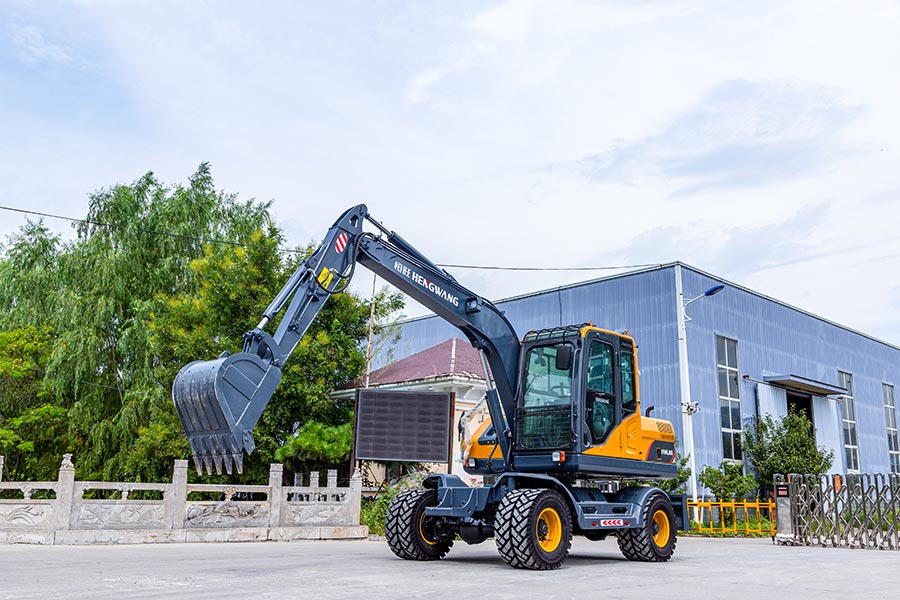
Daily “three checks”: before leaving the vehicle, during operation, and after closing the vehicle
Check before leaving the vehicle (5-minute quick troubleshooting)
Fluids: check engine oil (oil level between the upper and lower limits of the scale, no emulsification, blackening), coolant (level not lower than the lowest scale, no leakage), hydraulic oil (oil level above the center line of the observation window, no foam, impurities), transmission oil (oil level up to standard when cold, to avoid lack of oil leading to wear of gears).
Tires: check the tire pressure (according to the standard of the manual, usually the pressure is different for empty/heavy load), remove stones and nails in the tire tread (to avoid puncture or blowout), and observe whether the tread wear is even (partial grinding may be the result of wheel loosening or positioning problems).
Key components: check whether the bucket and moving arm connecting pins are loose (try to screw them with a wrench), whether there is any leakage in the hydraulic pipeline (no oil stains at the joints), and whether the brake pedal travels (there is no false position after stepping down, and the parking brake can be reliably locked).
Observation during operation (real-time monitoring of abnormalities)
Listen to the sound: engine, transmission, hydraulic pump operation without abnormal noise (such as “click” metal friction sound may be gear damage, “hiss” sound may be hydraulic pipeline leakage).
Look at the instrument: water temperature (normal 80-90 ℃, over-temperature may be radiator clogging), oil temperature (hydraulic oil temperature does not exceed 80 ℃, too high will accelerate the aging of the fluid), oil pressure (oil pressure is too low may be the filter element clogging or oil pump failure).
Sensory operation: whether the bucket lifting / lowering is stuck or not (may be the hydraulic valve stagnation), whether the steering is light or not (heavy may be the steering oil lack of oil or pump damage).
Maintenance after repossession (key to prolonging component life)
Cleaning: Rinse the body with water (avoid high-pressure direct spraying of electrical parts), remove mud and stones in the bucket (to prevent freezing at night and stalling in the next day's operation), and dry the cab glass and mirrors (to ensure a clear line of sight).
Tightening: check the tire bolts and bucket pin nuts (easy to loosen after heavy load, use torque wrench to tighten them according to standard torque).
Reset: put the bucket flat on the ground (to avoid long-term stress on the boom cylinder), pull the handbrake, and turn off the power switch (to prevent the battery from losing power).